Business Insurance
Report: Market Forces Reshaping Risk in 2026
Emerging global rules, rising cyber exposures, and shifting property conditions are some of the forces redefining risk in 2026.
April 21, 2026
The commercial insurance marketplace continues to evolve rapidly in 2026, driven by geopolitical uncertainty, accelerating digital risks, and heightened scrutiny in mergers and acquisitions. While some lines of coverage are stabilizing or even softening, others face growing complexity and volatility. Hylant’s latest Commercial Insurance Market Update provides a detailed look at what businesses should expect and how they can prepare.
This post dives into three of the 16 coverage types contained in the report: international casualty, cyber, and property.
Global Programs Face Expanding Regulation and Rising Complexity
International casualty markets remain competitive, with stable pricing and sufficient capacity. However, below the surface, global risk conditions are becoming significantly more challenging. New and evolving regulations, geopolitical friction, and rising litigation trends across regions are reshaping risk profiles for multinational organizations.
One of the most impactful developments is the European Union’s expanded Product Liability Directive, which takes effect on December 9, 2026. The revised directive broadens the definition of “products” to include software, AI systems, digital services, and connected components. It also lowers the burden of proof for consumers and introduces new categories of potential harm, including psychological injury and data loss. For many businesses, this results in longer liability tails, higher claim severity, and wider exposure—particularly for companies with digitally enabled products or IoT‑dependent operations.
The EU is also experiencing growth in class action activity, driven by the Representative Actions Directive. This more harmonized approach to collective legal action increases the likelihood of high‑severity claims that span multiple markets and legal jurisdictions.
China presents its own set of challenges. The recent expansion of Cash Before Cover requirements now applies to all coverages, meaning policies provide no protection until the premium has been paid. Additionally, insurers may be forced to revise policy wording, as new rules require that only filed and approved clauses be included in coverage terms. This shift adds pressure to global programs that depend on customized coverage structures.
In parallel, geopolitical fragmentation, regulatory divergence, and rising tensions are pushing global carriers toward more conservative underwriting. Underwriters now demand higher‑quality exposure data, more granular schedules, and clearer operational visibility. For insureds, the message is clear: businesses must bring greater precision and documentation to renewals and submissions to maintain favorable terms across borders.
Cyber Threats Intensify as AI Transforms the Attack Surface
Cyber risk remains one of the most dynamic and rapidly evolving areas of commercial insurance. While capacity remains abundant, insurers are responding to a surge in claims activity, particularly around ransomware, business email compromise (BEC), and AI‑enabled attack vectors.
Ransomware remains the most dominant driver of losses, but the nature of attacks is shifting. AI is enabling cybercriminals to launch more sophisticated phishing and social engineering campaigns, automate attack steps, and accelerate exploitation timelines.
Geopolitical tensions are amplifying systemic cyber risk. Nation-state actors are increasingly targeting critical infrastructure, supply chains, and cloud platforms. This elevates the importance of not only carrying cyber insurance but also ensuring that the policy language reflects the organization’s specific operational and systemic exposures.
Insurers emphasize that strong cybersecurity controls are now the baseline expectation. Businesses with multifactor authentication, improved network visibility, ongoing employee training, and mature incident response capabilities continue to secure the best pricing outcomes, often achieving flat renewals or modest increases despite broader market hardening.
Property Market Softens, but Risk Quality Remains Crucial
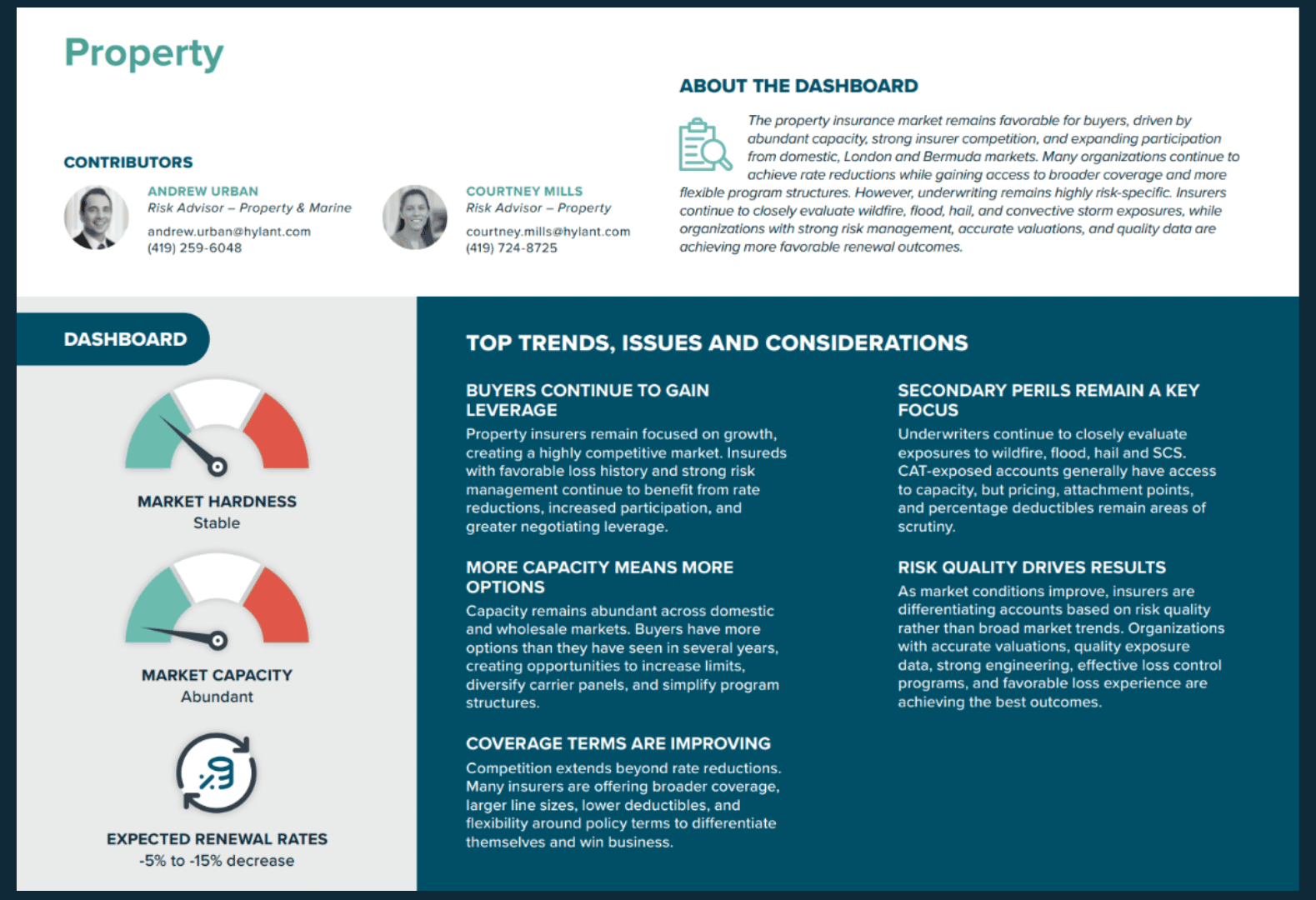
The 2026 property insurance market is generally softer than in recent years, both in pricing and capacity. Rates continue to ease as abundant capital creates competition among carriers. Many insureds are seeing meaningful reductions in renewal pricing, ranging from 5% to 15%, depending on risk characteristics.
Even so, the property market is far from risk-free. Catastrophe exposure remains elevated, and secondary perils, such as hail, wildfire, and non-hurricane wind events, are drawing heightened scrutiny. These more frequent, less predictable events are reshaping how insurers evaluate risk and structure deductible frameworks. As a result, even in a softer pricing environment, underwriters are deploying capacity more selectively, particularly for risks with challenging construction types, high-hazard locations, or loss history concerns.
Insurers continue to emphasize accurate valuation data and well‑supported COPE (Construction, Occupancy, Protection, Exposure) details. Organizations that can demonstrate strong risk management practices, updated replacement cost valuations, and progress on engineering recommendations tend to secure the most favorable outcomes. Soft market conditions create an opportunity for buyers to improve terms and structure, but only if they can present clear, accurate, and compelling data.
Additionally, deductible structures and key coverage terms remain important considerations. Even as pricing decreases, many property programs still contain meaningful risk-sharing features. This period of market softening offers a timely opportunity to revisit deductibles, sublimits, waiting periods, and peril‑specific triggers to ensure programs respond as intended when losses occur.
Download the Commercial Insurance Market Update
This blog highlights only a fraction of the insights available in our latest report. For a quick analysis of all commercial coverage lines, download the complete Market Update. Equip your organization with the knowledge needed to navigate a rapidly changing risk landscape.
The above information does not constitute advice. Always contact your insurance broker or trusted advisor for insurance-related questions.